William Makis: The Truth Behind A Disgraced Doctor Turned Online Predator
How the COVID-19 pandemic allowed him to rise to fame and fortune, by exploiting the public's trust.
In recent years William Makis has become known for his disputes with Alberta’s medical authorities, his promotion of alternative cancer therapies, and his repeated claims that sudden deaths reported online were linked to COVID-19 vaccines. Barred from practicing medicine in Canada, he has nevertheless built a very comfortable online income, earning more than $50,000 a month from Substack alone, as indicated by the platform’s purple “Bestseller” badge.1 He also has 650,000 followers on X and is objectively one of the most prominent representatives of the “medical freedom” movement.
To be clear, the purpose here is not to attack alternative cancer treatments, but to expose a habitual liar. For many vaccine skeptics, Makis is a hero, supposedly persecuted by the authorities. For those outside that community who know his name, he embodies everything that is wrong with the “antivaccine movement.”
What follows is the gap between that mythology and the record.
The public version of Makis is that of a courageous doctor destroyed for speaking out. The documented version is something else entirely: a physician whose Alberta career steadily collapsed under the weight of his own conduct - intimidation, harassment, sexualized behavior toward staff, incessant grievance-making, and a compulsive tendency to recast every professional consequence as proof of a conspiracy against him. By 2017, the final blows to that career had already landed. Thereafter, rather than accept what had happened, Makis began suing, or threatening to sue, an ever-expanding cast of enemies, widening the circle of supposed persecutors until virtually anyone who contradicted him could be folded into the plot. That pattern would culminate in the most deserved of designations: vexatious litigant.
The same opportunism would later reappear during COVID. Depending on the audience and the moment, Makis could posture as provaccine in one thread and antivaccine in another, only to later delete whichever version no longer served the persona he was trying to construct. The details changed, the method did not: say whatever was useful, erase whatever was inconvenient, and present the resulting fiction as a coherent history.
There are many ways to approach the case of Viliam Makis. The most effective, however, is to present his version of events first, and then compare it with the record, showing how consistently it slides from distortion into outright falsehood.
Of the many hours of Makis interviews reviewed for this article, none was more revealing than episode #781 of the Shaun Newman Podcast.2 Newman, a former professional hockey player well known in Canada, appears to be a decent man. He is also, just as clearly, not an experienced interviewer. He did no apparent homework on his guest, let him speak uninterrupted for long stretches, and never seriously challenged what he was saying. It is dreadful journalism, but it gave Makis a perfect opportunity to outdo himself. The full transcript can be consulted afterward;3 for now, let us begin with the shortest possible excerpt. The “lie counter” and the comments on the right are my additions, and each instance will be examined in turn below.
Because that is the central fact of this entire story: absolutely nothing in the record fits Makis’s preferred version of events. Not his fall in Alberta. Not the destruction of his medical career. Not the lawsuits. Not the reinvention that followed. The closer one looks, the less this resembles a dissident crushed by power, and the more it looks like a man who answered every exposure, every sanction, and every failure by enlarging the conspiracy and asking the public to mistake escalation for evidence.
From Slovakia to Montreal’s McGill University
Viliam “William” Makis was born in Žilina, Slovakia, in 1979,4 when the country was still part of Czechoslovakia. At age 9, he left with his family as they fled communism. He spent a year in a refugee camp near Belgrade, Serbia, where he learned English. His father, an engineer with a PhD, eventually secured the family’s immigration to Canada. They settled in Toronto, where his father obtained a university professorship.5
After earning a B.Sc. in immunology from the University of Toronto, Makis graduated from McGill University in 2005. He then completed specialty training in nuclear medicine at McGill and obtained Royal College certification in 2010. He moved to Manitoba with his wife and two young children to take up the post of Director of Nuclear Medicine at Brandon Regional Health Centre, where he practiced until 2013.6 7
2013: From Manitoba to Alberta
In June 2013, Makis began negotiations with Dr. Robert MacEwan, Director of Diagnostic Imaging at the Cross Cancer Institute in Edmonton, Alberta.8 On June 26, MacEwan offered him a contract with remuneration set at $646,335.00, together with a $10,000 relocation allowance to cover his move from Brandon, Manitoba. Makis signed the agreement on August 2, and Makis started working at the CCI on August 5.
This first contract was temporary and subject to several conditions: Makis had to obtain licensure from the College of Physicians and Surgeons of Alberta (CPSA),9 receive an appointment to the AHS Medical Staff, secure clinical privileges at the Cross Cancer Institute (CCI), obtain medico-legal protection from the CMPA, and pass a security check.10
Having satisfied these conditions, Makis signed a second contract a few months later, on November 29, 2013. It consisted of a Medical Services Agreement (MSA) between AHS and Makis’s professional corporation, Makis P.C., together with a Contractor & Practitioner Agreement (CPA). Whereas the first agreement had been made with him personally in connection with his relocation, the November MSA formally transferred the financial arrangement to his professional corporation, which had been incorporated a month earlier, on October 30, 2013.11
This was a standard arrangement for physicians in Canada and typically offered significant tax and business advantages.12 The remuneration remained unchanged, and the contract was set to expire on October 31, 2016. Both parties entered it on the understanding that, absent exceptional circumstances, AHS routinely renewed such agreements.13
At that stage, the record shows Makis entering Alberta on generous and entirely conventional contractual terms.
2014: Clinical Work and First Turmoil
In January 2014, Brent Schaitel, a nurse, joined the CCI as a close collaborator of Makis.14 Around the same time, and at the request of Robert MacEwan and Alexander “Sandy” McEwan, who had until then been handling the necessary clinical work at the institute, Makis started seeing patients.15
By February, he was already complaining that he was overworked and needed “research days” on which he would see no patients.16
Relations between Makis and MacEwan began to deteriorate in July 2014. On July 29, after Makis again complained of being overworked, Robert MacEwan suggested that he manage his time more efficiently by delegating part of the workload associated with the clinical trial he was conducting with Sandy McEwan to nurses.17
The tension came to a head a week later. On August 6, MacEwan visited Makis’s office to discuss these workload issues. When he asked Makis to bring such problems directly to him, rather than copying four or five people on every email, Makis later claimed that he had “felt” he “was being interrogated... and threatened” by this “tall and imposing figure.”18
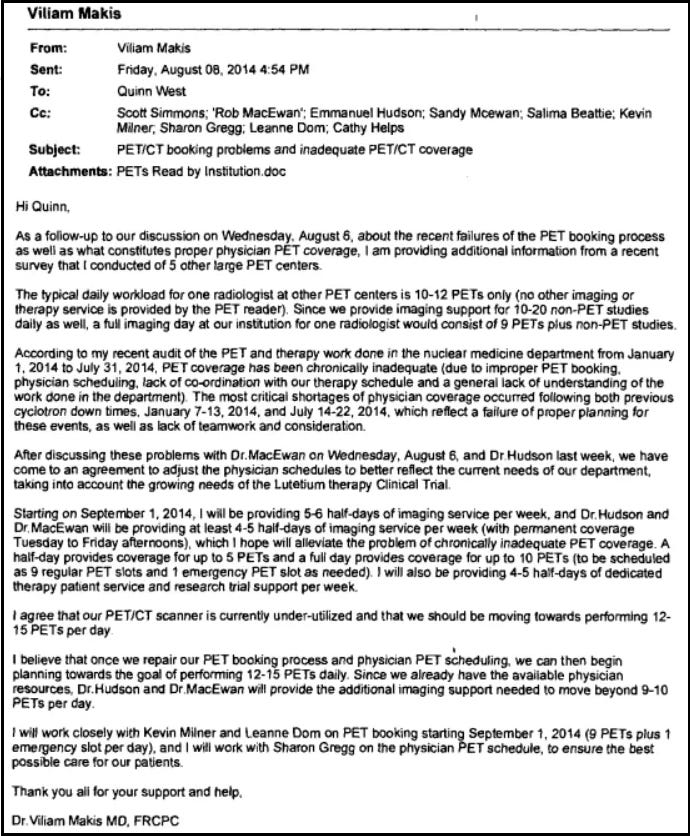
Two days later, on Friday, August 8, six minutes before the end of the day, Makis responded in his own fashion. He emailed AHS Director Quinn West - and nine other recipients, including Robert MacEwan - with his own instructions on how to “adjust the physician schedules,” a task that was, needless to say, MacEwan’s responsibility.19
The following Monday, August 11, Makis formally escalated the dispute. At 1:23 a.m., he sent Matthew Parliament, their mutual superior, via Parliament’s secretary, Salima Beattie, a lengthy account of how he had “felt threatened” by MacEwan during the August 6 incident.20
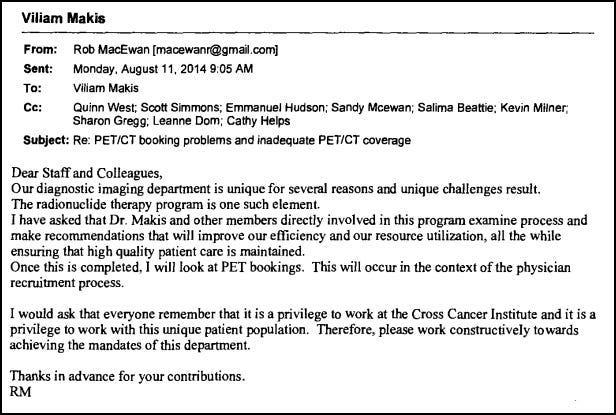
At 9:05 a.m., MacEwan replied to Makis’s provocation, reminding “everyone that it is a privilege to work at the CCI.”21
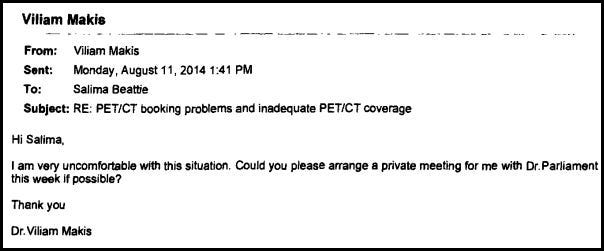
Twenty-seven minutes later, at 9:32 a.m., Makis bought and began carrying a voice recorder.22 At 1:41 p.m., he asked for a meeting with Matthew Parliament.23 By then, the pattern was already clear: grievance, documentation, escalation.
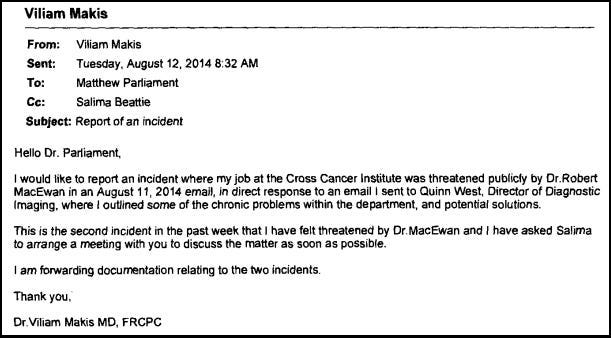
The next day, Makis reported the incident directly to Parliament.…24
… And, while his voice recorder happened to be running, he had another exchange with MacEwan.25
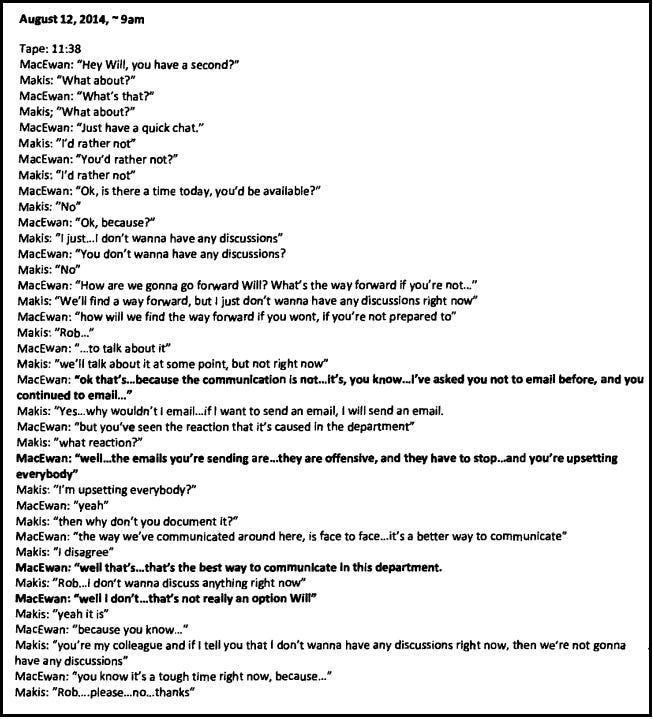
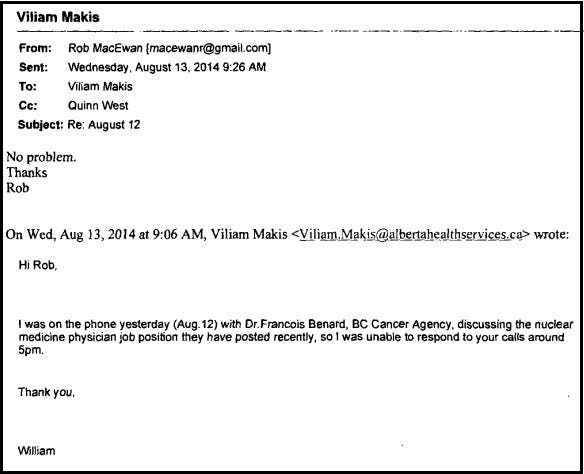
At 9:44 a.m., he again reported the incident to Parliament and,26 claiming that it had made him fear for his physical safety, began locking his office…27
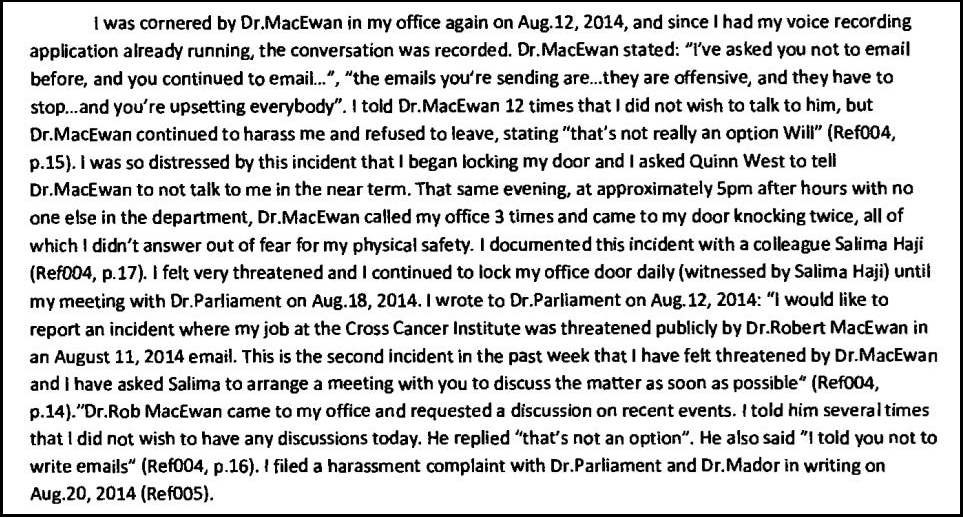
The following day, he emailed Robert MacEwan to explain “how unbearable” he found the situation.28
Makis responded to these “grave developments” in his usual measured fashion: by filing a formal complaint against Dr. Robert MacEwan with Dr. Matthew Parliament and Dr. David Mador on August 20, 2014.29 By then, Makis had transformed the episode into a formal grievance process.
The reader may judge for himself whether Makis had any legitimate reason to fear for his physical safety, or whether he was instead trying to provoke - and remove - the man who had recruited him the previous year.
On August 22, 2014, Dr. David Mador responded to the complaint by indicating that he preferred to resolve the matter through “mutual understanding” rather than through the formal bylaw process.30 He asked Dr. Matthew Parliament and Dr. Bill Anderson to meet with Makis and Dr. MacEwan to address the concerns. The two sides, unsurprisingly, remembered the outcome differently: Makis claimed that the incident had been entirely covered up,31 while Parliament considered that the concerns had been addressed by dealing with Makis’s perception that he was overloaded, and by mentoring MacEwan on his communication style.32
No other major incident occurred in Alberta in 2014, at least through December.
Makis merely sued his former Manitoba colleagues, Salem Yuoness, Shaun Gauthier, and Prairie Mountain Health, on December 22 - two days before Christmas.33 He would later refer, with apparent satisfaction, to the distress he had caused them, something his office colleagues found intimidating should they ever complain about him.34 35 36
Then, completely unsolicited, he sent a semi-nude photograph of himself (from the waist up) to Sarah Rayner, a nurse who was scheduled to be interviewed for a position in his department only a few weeks later, in early January 2015.37 Shocked, she replied: “You’re so not allowed to send me these sort of photos lol ridiculous.”
2015: Sexual Harassment and Escalating Misconduct
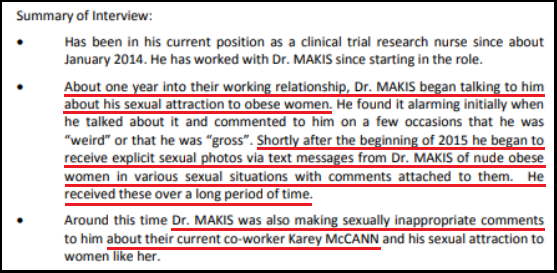
In January 2015, Makis first spoke to Brent Schaitel, the nurse working most closely with him, about his “sexual attraction to obese women.” Shortly afterward, he began sending Schaitel pornographic images accompanied by assorted comments.38 These events are described in Schaitel’s interview notes from late 2015, leaving little ambiguity about the pattern.
On January 26, 2015, Sarah Rayner successfully completed her interview, which had been postponed by a couple of weeks because of another doctor’s absence. On March 15, 2015, she joined Makis’s department. Makis quickly drew her into his circle of confidence, alongside Schaitel, and by July 2015 she too had become a target of his sexually obsessive behavior.39
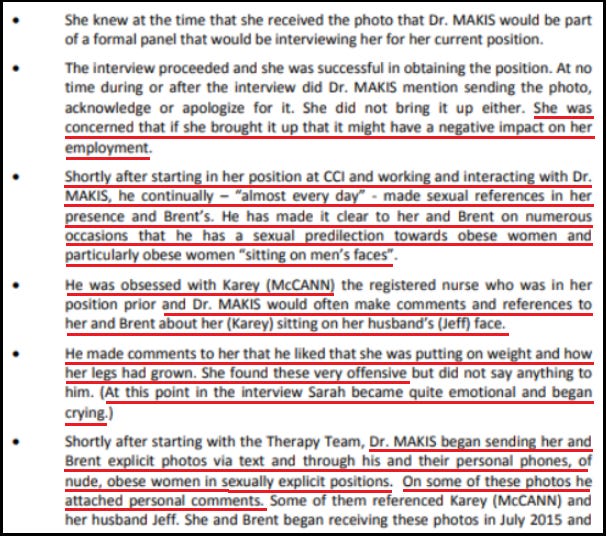
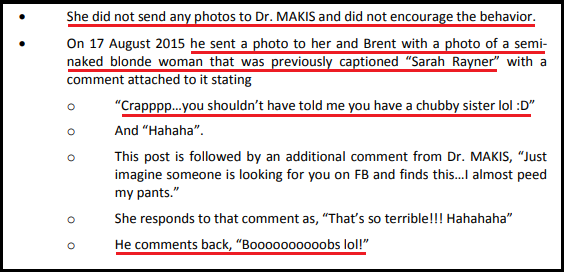
On August 17, 2015, Makis sent Sarah Rayner an erotic image explicitly labeled with her name.40
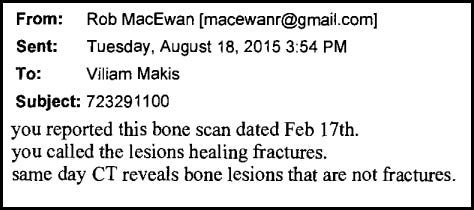
Makis’s professional performance was also far removed from the image he later tried to project. On August 18, 2015, Dr. Robert MacEwan informed him that he had made a diagnostic error.41
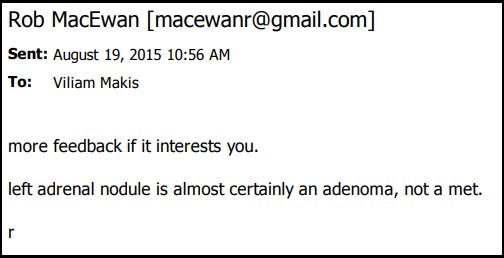
On August 19, 2015, MacEwan followed up with another correction.42
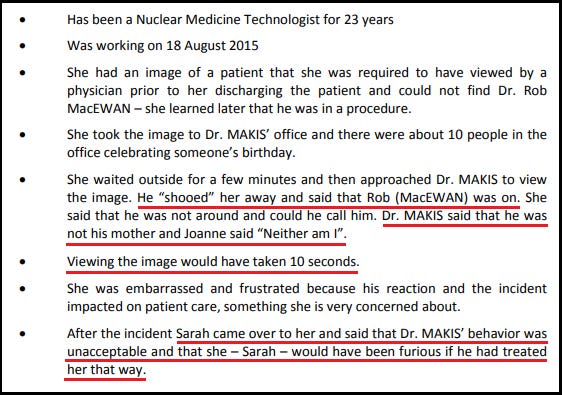
Makis responded to this routine professional feedback much as one might expect. He lashed out at Joanne Snydmiller for the offense of asking him to spend ten seconds reviewing a patient scan before the patient was released, at a moment when he was celebrating a birthday in the office and Robert MacEwan was not around. Sarah Rayner, who witnessed the incident, was concerned enough to comfort Joanne afterward.43
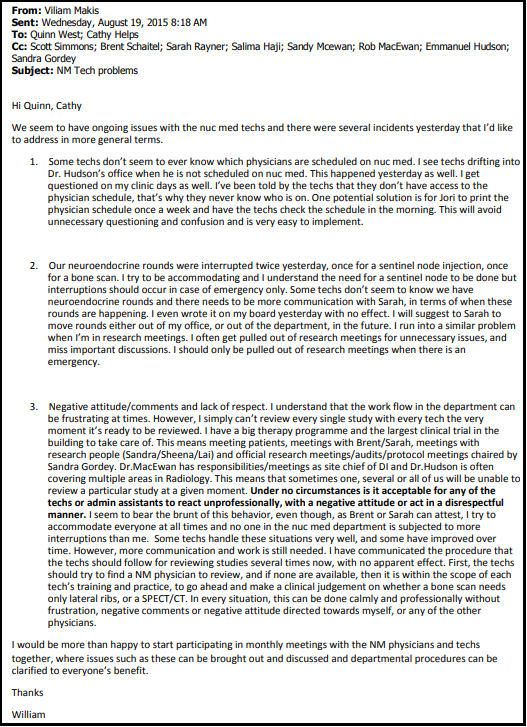
He also responded by sending Quinn West another lengthy email, copying the entire staff, about what he portrayed as “organisational issues” and the “unprofessional behavior of tech assistants.”44
He also responded in a third way: by printing a poster and hanging it on his office door.
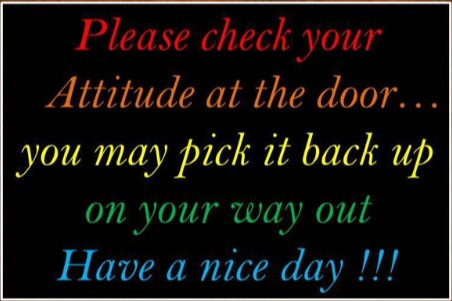
The poster triggered yet another confrontation, this time with Quinn West. When West came to Makis’s office to discuss his latest email, he was met with the sign on the door, which he quite properly regarded as completely unprofessional, not least because patients passed through that area.
Makis later described the episode as Quinn West “taking pictures of his office door without asking for permission and attempting to leave without explanation,” together with supposed “threats” either to cause him “disabling physical harm” or to “have him fired”.
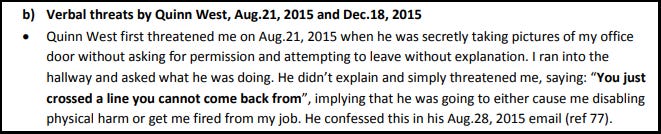
At the time, however, Makis himself insisted that it was “simply a joke.”45
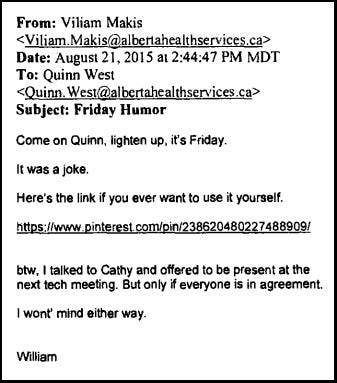
This sequence of incidents convinced both Quinn West and Robert MacEwan that recruiting Viliam Makis had been a mistake. Discussing the confrontation, MacEwan wrote plainly that he would henceforth advocate for the non-renewal of Makis’s contract.46
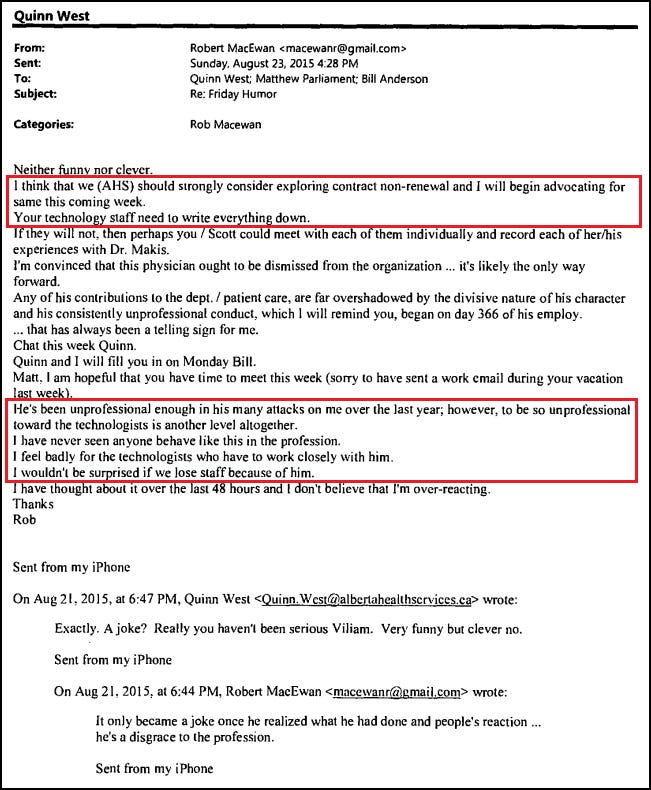
While West and MacEwan were concluding that Makis had become untenable as a colleague, his conduct toward Sarah Rayner was continuing to deteriorate.
By mid-October, Makis was still behaving grossly inappropriately toward Sarah Rayner. He again sent the semi-nude photograph labeled with her name to both Sarah and Brent. More disturbingly still, Makis told Rayner that he engaged in zoophilia and had “masturbated his cat.”47
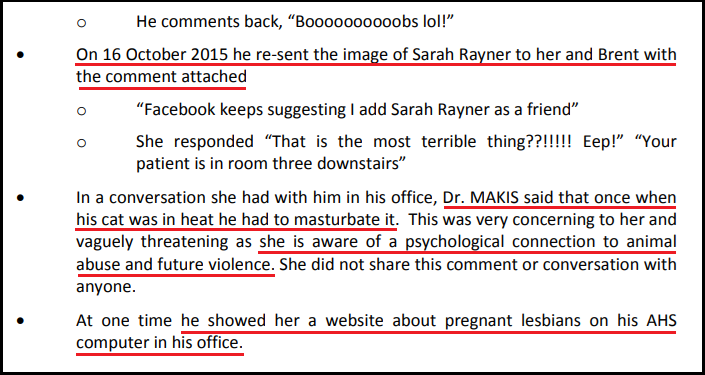
He also showed her, on his office computer, a website about pregnant lesbians. Makis’s professional performance, as well as his relationship with his team, continued to deteriorate as 2015 drew to a close. After taking some vacation time in November, he came back and finally turned against Rayner and Schaitel, who had committed, in his eyes, an act of lèse-majesté by scheduling too many patient appointments for him.
True to form, rather than resolving the scheduling conflict quietly or speaking with the nurses directly, Makis fired off a mass email on November 27 titled “Therapy problems”. He copied the therapy nurses, clerks, and a wide distribution list of staff members - some entirely external to the issue - publicly berating the nursing team for what he claimed were "wait-list" and "dosing mistakes".48
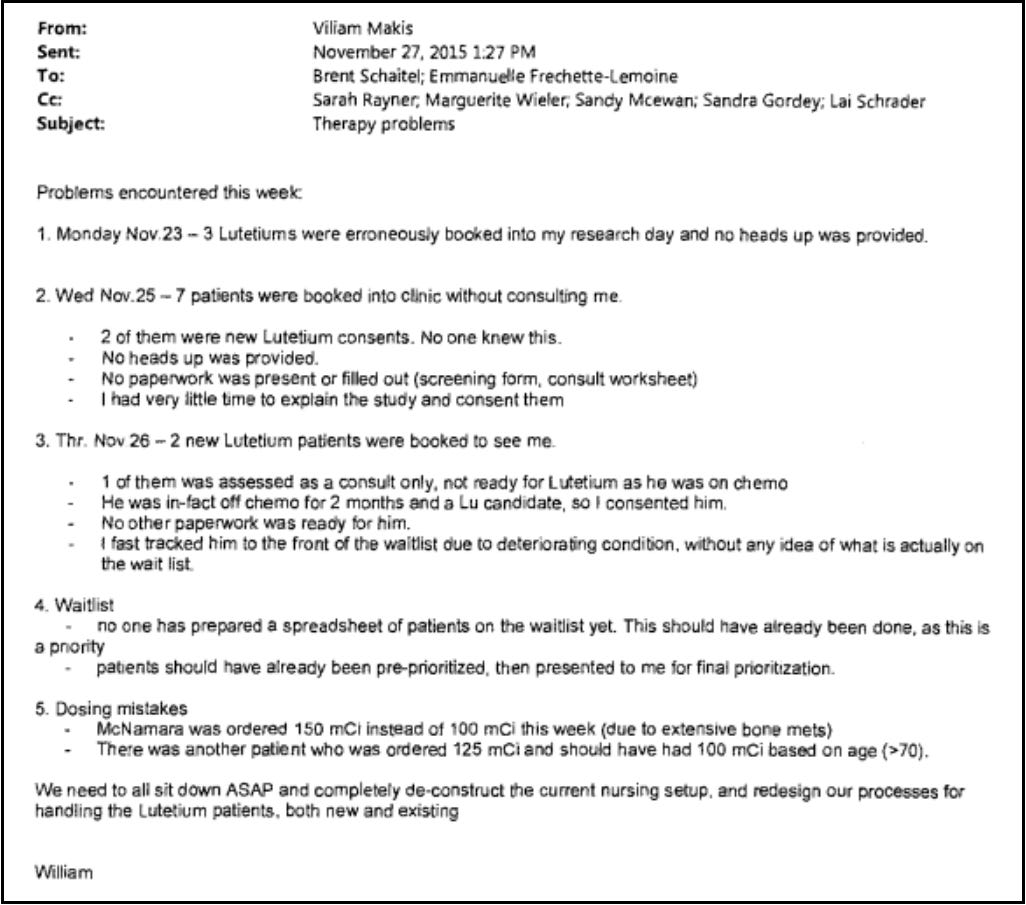
The nursing staff, who had been bending over backwards to accommodate his erratic schedule and last-minute vacations, saw the email as a deliberate attempt to shame and humiliate them after more than a year of enduring an already toxic work environment. This time, they did not simply absorb the abuse. On December 3, 2015, nurses Sarah Rayner and Brent Schaitel, together with clerk Emmanuelle Frechette-Lemoine, submitted a formal complaint to Facility Medical Director Dr. Matthew Parliament and Dr. Robert MacEwan. They described Makis’s unprofessional conduct, his inflammatory communications, and his growing habit of publicly humiliating staff.49
In a final attempt to de-escalate the situation, AHS leadership arranged a meeting on December 10 with Makis, the nurses, Marguerite Wieler (PhD, MSc), and Dr. Sandy McEwan to address the scheduling disputes. The meeting was a disaster. Witnesses later recalled that Makis was visibly angry, rude, and condescending toward the nursing staff throughout.50 51 52 53
Later that same day, Makis took to Facebook and posted a photo of a “bloody Viking face” with the ominous caption, “so many betrayals to repay.” Brent Schaitel, who was Facebook friends with Makis, saw the post the next morning, took a screenshot, and shared it with Rayner. Given Makis’s escalating hostility, along with his frequent and boastful reminders around the clinic that he was actively suing his former colleagues in Manitoba, the nurses interpreted the bloody Viking image as a direct physical and professional threat. Makis deleted the “bloody Viking” the following day and blocked Rayner and Schaitel on Facebook a few days later.54
Sarah Rayner overcame her embarrassment and raised the matter, informing Sandy McEwan of the stream of pornographic images she had received. On McEwan’s advice, she escalated the issue on December 23, 2015, by filing a formal complaint directly with the College of Physicians and Surgeons of Alberta (CPSA), attaching the inflammatory emails, the social-media threats, and five pages of the explicit photographs Makis had sent her.
Armed with both the internal staff complaints and the explosive CPSA filing, AHS leadership finally took decisive action. On December 29, 2015, the Acting Zone Medical Director, Dr. David Mador,55 officially notified Makis that a Triggered Initial Assessment (TIA56) was being launched to investigate his conduct.57
Makis agreed to a voluntary paid administrative leave until the TIA was concluded, the alternative being that AHS would immediately suspend his hospital privileges and take action. Makis was asked to relinquish, and did relinquish, his hospital identification, his CCI office keys, and access to his AHS email account for the duration of his “voluntary” paid administrative leave.
2016: Administrative Exile
From January 7 to January 19, 2016, the TIA team interviewed the complainants- Sarah Rayner, Brent Schaitel, and Emmanuelle Frechette-Lemoine - as well as the witnesses Robert MacEwan, Quinn West, Matthew Parliament, and Sandy McEwan. On January 20, 2016, Makis submitted to Dr. Mador and Dr. Anderson a 100-page letter devoted largely to attack Robert MacEwan.
The full 47-page TIA report, which Makis, for obvious reasons, was always careful to reproduce only in short extracts in his subsequent proceedings,58 59 can be downloaded below.
Two days later, Makis himself was interviewed. He was assisted by Donald Cranston, a Harvard graduate and, obviously, an excellent lawyer.60
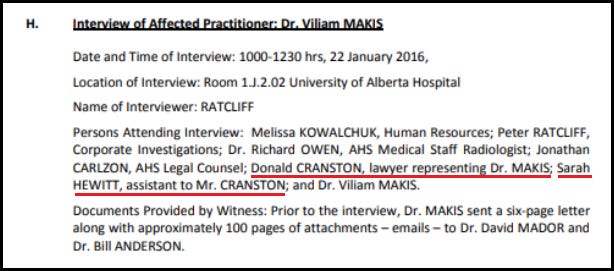
During his January 22, 2016 interview with the TIA team, Makis employed a dual strategy of aggressive deflection and minimized admissions.
True to his pattern of narcissism, Makis vehemently denied being the aggressor, instead framing himself as the victim of a coordinated plot. He argued that Quinn West was an incompetent manager and insisted that West, Dr. MacEwan, and the nursing staff were actively sabotaging his medical practice.
He defended his habit of sending mass emails, arguing that they were entirely justified because the recipients were tangentially involved in clinical trials, and that this was his only way of escalating unresolved issues. When confronted with the menacing “bloody Viking face” Facebook post captioned “so many betrayals to repay,” Makis absurdly claimed that it was merely a coincidence, a reference to a television show, and harmless in intent. He likewise dismissed the aggressive poster he had hung on his office door as “a joke.”61
Despite these evasions, Makis was forced to acknowledge several damning facts. Most notably, he admitted to sending explicit pornographic photographs and inappropriate texts to Sarah Rayner and Brent Schaitel, while repeatedly making sexual “jokes” during office hours.62 He nevertheless attempted to excuse these serious boundary violations by claiming that he believed their “casual work” relationship made such communications acceptable, and by denying that any power differential existed between doctors and nurses.63
He also admitted to repeatedly telling staff members, “I have a good lawyer,”64 whenever they challenged his behavior - a tactic witnesses described as blatant intimidation. Furthermore, Makis had to concede that his colleagues’ knowledge of his ongoing, vindictive lawsuit against former colleagues in Manitoba might deter them from filing complaints against him, although he insisted that he had mentioned it innocently.65
Rather than quietly awaiting the TIA panel’s verdict, Makis flooded AHS executives with hundreds of pages of emails and letters, alleging that MacEwan and West were coercing staff into filing false complaints. This forced the TIA team to extend its investigation and re-interview witnesses. Unsurprisingly, the technologists explicitly denied having been pressured or traumatized by AHS leadership, thoroughly debunking Makis’s uncorroborated conspiracy claims.66
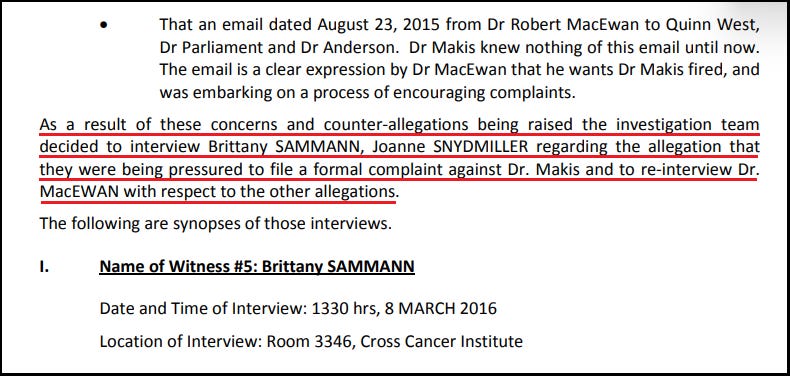
On May 11, likely realizing that his position was highly precarious, Makis formally withdrew from all clinical therapy work and research at the CCI, presenting the move as a sign of “good faith” toward the complainants.67
On June 1, Makis filed a lengthy formal complaint with the College of Physicians and Surgeons of Alberta (CPSA) against Dr. MacEwan, accusing him of physical assaults, harassment, and sabotage of his medical career.68
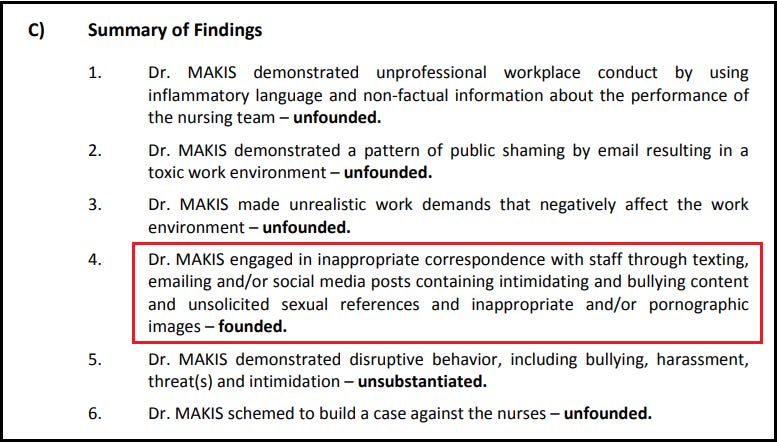
On June 14, the 47-page TIA report was finalized and delivered to Makis’s counsel. The independent investigation rejected all of Makis’s counterclaims of conspiracy and sabotage as unfounded.69 The panel found well founded the allegation that Makis had sent inappropriate, intimidating, and pornographic communications to his staff - the only accusation that even his excellent lawyer could not meaningfully downplay.70
On July 8, Dr. Michael Caffaro dismissed Makis’s June 1 complaint against Dr. MacEwan, finding insufficient evidence of unprofessional conduct.71 Days later, on July 11, AHS Zone Medical Director Dr. David Mador formally issued his decision on the TIA. He offered Makis a consensual resolution: voluntarily relinquish his hospital privileges and agree not to seek renewal of his contract, in exchange for the TIA being halted. Makis rejected the offer.72
On July 15, a new physician, Kelly Chiu, was recruited to replace Makis - and his former office was given to her.73 On July 29, AHS sent a notice advising Makis that it wouldn’t be renewing the MSA at the end of its initial term.74
On August 11, Makis informed AHS that he no longer agreed to remain on paid leave, that he was ready, willing, and able to return to work, and that he would undergo whatever training the TIA panel recommended. He demanded the return of his hospital keys and access to his email account. In circumstances where three employees had made clear that they would resign if he returned, AHS firmly refused to allow it.75 On September 8, Dr. David Mador escalated the matter by formally referring Makis's conduct directly to the CPSA for regulatory review.
On October 7, the CPSA concluded its own investigation into the nurses' complaints. Echoing the TIA report, the College of course officially confirmed that Makis's communications and conduct toward staff had severely crossed professional boundaries.76
On October 27, four days before his contract expired, Makis launched a scorched-earth legal offensive. He sued AHS in the Alberta Court of Queen’s Bench for $13.5 million, alleging breach of contract, negligence, wrongful termination, malfeasance in public office, and an elaborate conspiracy to destroy him.77 78
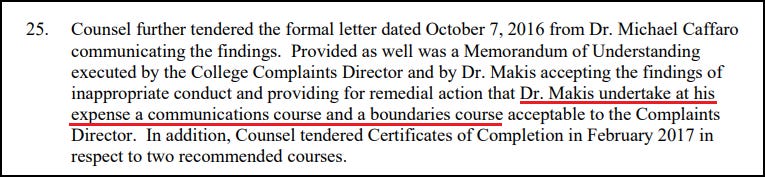
In November & December 2016, despite filing a second CPSA complaint against Dr. MacEwan (which was quickly dismissed),79 and flooding the system with appeals, Makis quietly capitulated to the regulatory body. On December 17, 2016, he signed a Memorandum of Understanding with the CPSA, officially accepting their findings of his inappropriate conduct and agreeing to undertake mandatory boundary and communications courses, at his own expense.80
2017: Escalation, Paranoia, and More Self-inflicted wounds
Increasingly isolated, Makis spent the year lashing out in every direction: the University of Alberta severed its remaining ties with him; he bombarded public bodies with FOIP requests and complaints; and he escalated his litigation and grievance campaigns against anyone he could cast as an enemy. For example, Alexander “Sandy” McEwan, whom Makis had until then presented as another victim of Robert MacEwan alongside himself, also became, in his telling, yet another conspirator.81
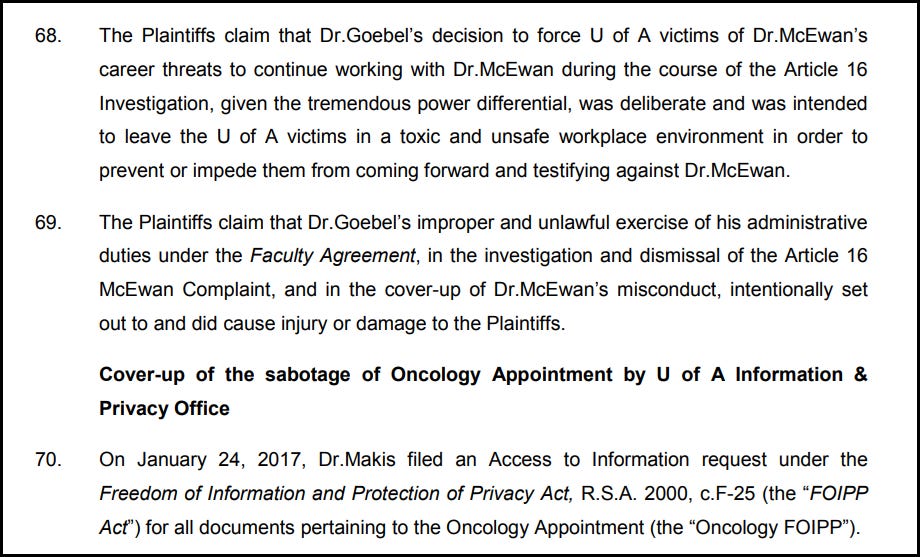
The year’s most serious incident came in April, when, according to later tribunal findings, he confronted Dr. Marguerite Wieler in Toronto over her cooperation with the CPSA, accused her of lying, and threatened to destroy her livelihood - events he would later deny in their entirety.82
Over the following months, Makis transformed each setback into fresh “proof” of a supposed plot against him. On June 3, 2017, AHS offered him a $400,000 settlement in exchange for a full release of his “beautiful $13.5 million lawsuit.” Makis allowed the offer to expire by failing to respond by June 9, 2017.83 84
Makis claimed that CPSA Complaints Director Dr. Michael Caffaro was the primary enforcer of Dr. Belanger’s retaliation. He alleged that exactly “six business hours” after he rejected the settlement on June 9, Dr. Caffaro launched a formal, fabricated CPSA investigation against him. As with most of Makis’s claims, however, his timeline and allegations of a coordinated extortion plot were entirely uncorroborated and collapsed under the most basic scrutiny. During the subsequent CPSA hearing, the evidence showed that the investigation into Makis, which stemmed from his aggressive confrontation with a former colleague, Dr. Marguerite Wieler, in Toronto, had actually been opened on May 8, 2017, by Associate Complaints Director Dr. John Ritchie - a full month before AHS even offered the $400,000 settlement.85
By autumn, the CPSA had completed its investigation into the April Toronto incident and determined that it warranted a disciplinary hearing.86 On October 16, 2017, CPSA legal counsel Craig Boyer attempted to serve Makis with a Notice of Hearing by registered mail to his home. Makis refused to accept the package.87 Instead, on October 20, he marched into the Edmonton Police Service and filed a witness statement absurdly alleging that Craig Boyer was delivering “forged and fraudulent government documents.”88 He then emailed the CPSA Registrar, demanding that the CPSA’s Complaints Director and Investigator be immediately removed from the premises and their computers confiscated to prevent “the biggest public corruption scandal in recent College history.”89
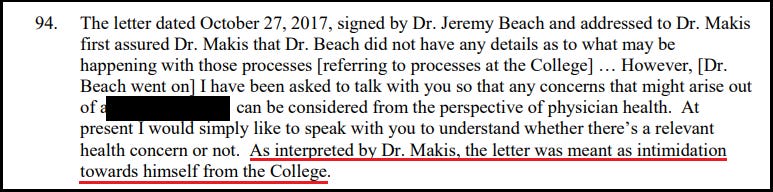
Observing his spiraling paranoia, Dr. Jeremy Beach of the CPSA wrote to Makis on October 27, 2017, gently suggesting a conversation to assess whether he might be suffering from a “relevant health concern” affecting his fitness to practice. Makis, of course, interpreted this standard physician-health inquiry as “intimidation towards himself from the College.”90
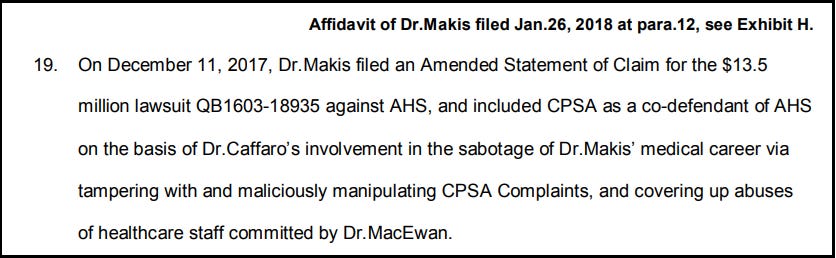
By the end of the year, having alienated the hospital, the university, and his regulatory body, Makis doubled down. In December 2017, he formally amended his $13.5 million lawsuit to add the CPSA as a co-defendant, ensuring that his legal battles would consume the years to come.91
2018: Disciplinary Action and Vexatious Litigant Designation
The consequences of Makis’s escalating paranoia and relentless retaliatory campaigns finally caught up with him in 2018. On January 15 and 16, 2018, Makis faced a CPSA Hearing Tribunal regarding the Toronto confrontation with Dr. Wieler. Acting as his own legal counsel (as he had alienated himself his former councils), he vehemently denied the incident and instead used the hearing to argue that the charge was merely part of a vast, institutional conspiracy to destroy his medical practice. He repeatedly presented his uncorroborated theory that the entire disciplinary proceeding was fabricated retaliation for his refusal of the AHS $400,000 settlement offer.92
In May 2018, AHS filed a formal application to have Makis declared a vexatious litigant, citing his relentless barrage of complaints - 106 proceedings in total - across multiple public agencies.93 Weeks later, on June 5, the CPSA tribunal delivered its verdict on the Toronto incident, completely rejecting his conspiracy theories and finding him guilty of unprofessional conduct for threatening his former colleague.94 During the subsequent sanctions phase, Makis - aptly illustrating the old saying that “the man who is his own lawyer has a fool for a client” - refused to address the question of sanctions and instead… demanded that the guilty verdict be overturned.
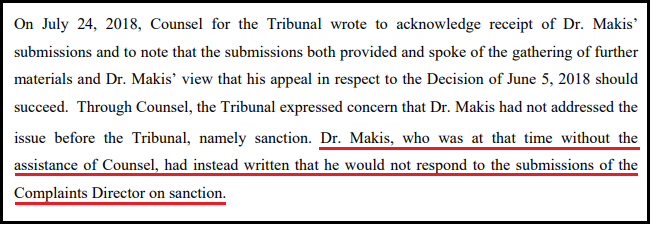
He further escalated his erratic behavior by emailing the Complaints Director and CPSA counsel to… declare that their careers were over.95
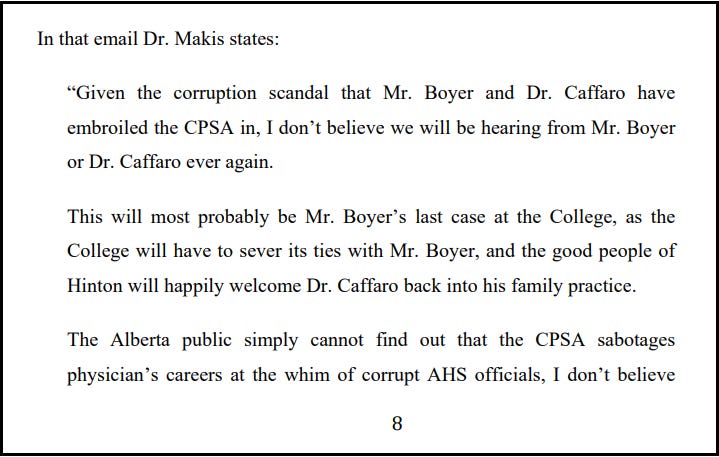
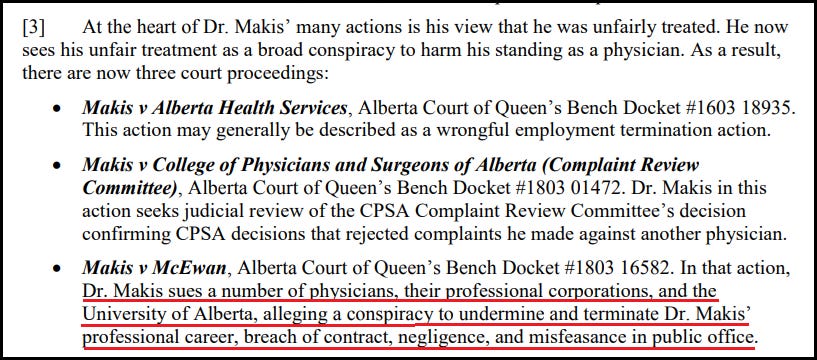
He also filed complaints with the Law Society alleging that his own former counsel and the CPSA's counsel had attempted to extort him into falsely claiming a mental impairment.96 Unfazed by the various rulings against him, Makis launched a second massive lawsuit in August - this one demanding $22.2 million against several physicians and the University of Alberta for their alleged roles in his downfall.97
On October 29, the CPSA issued its final sanction decision. Highlighting severe, ongoing concerns for public safety and Makis's fitness to practice, the tribunal formally reprimanded him, ordered him to pay the hearing costs, and mandated that he undergo a multidisciplinary fitness-to-practice assessment. The tribunal explicitly ruled that failing to arrange or attend this assessment would result in the immediate suspension of his medical practice permit.98
On December 3, 2018, Justice T.D. Clackson issued a comprehensive ruling, formally declaring Makis a vexatious litigant.99 Noting his “metastatic pattern of complaints, lawsuits, and appeals,” the court imposed sweeping gatekeeping restrictions, barring Makis from initiating any further judicial or non-judicial proceedings (including complaints to professional or public bodies) without prior court approval.
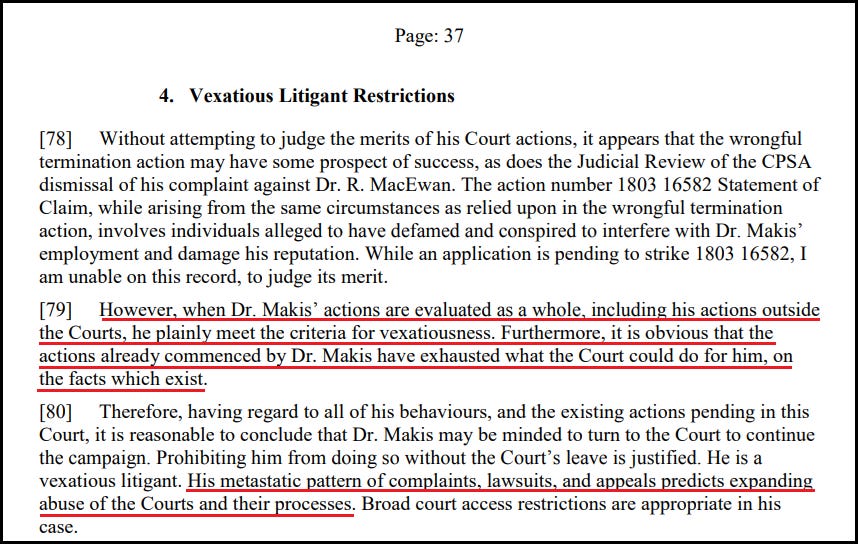
The judge also found Makis in civil contempt of court for his refusal to attend questioning, levying an additional $1,000 penalty.
2019: Appeals, Twitter Megaphone, And Licence Cancellation
By 2019, Makis was simply relocating the same persecution narrative from administrative bodies to the appellate courts and social media.
On February 12, his license was canceled for non-payment of the various legal fees he had accumulated with the CPSA.100
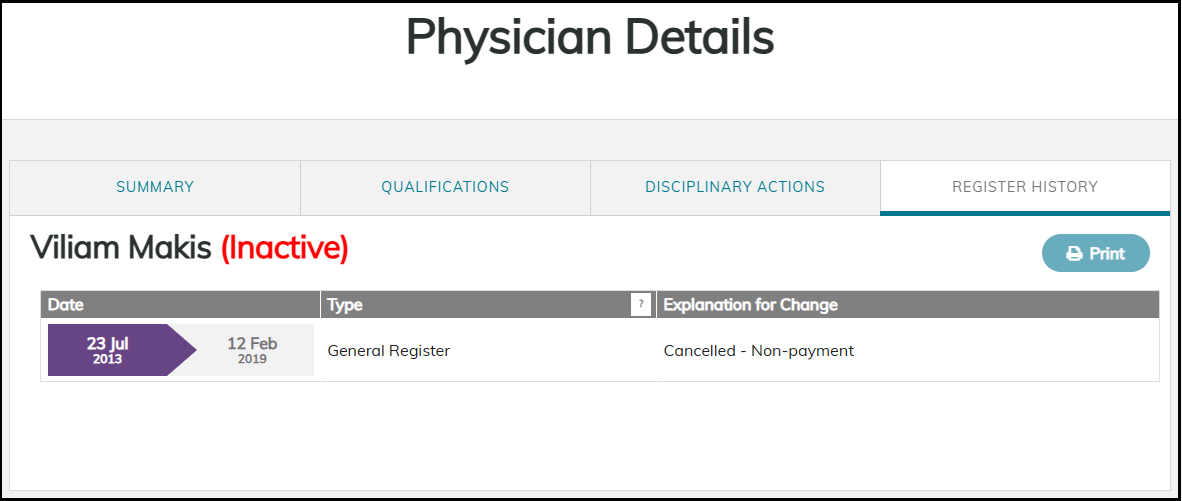
On March 26, 2019, the Court of Appeal refused to suspend the vexatious-litigant order.101
Meanwhile, Makis narrowly escaped further legal penalties. On May 31, a judge dismissed an AHS application to hold him in contempt for contacting prohibited individuals, generously concluding that he simply “did not understand the nature and breadth” of the court’s no-contact order.102
In July, the sheer scale of his paper warfare became impossible to ignore, with the Information and Privacy Commissioner stepping in as an intervenor while Makis flooded institutions with filings and requests. The IPC noted that he had an astonishing 35 active files with its office, all of which had been paralyzed by his vexatious-litigant designation.103
Later that month, on July 31, Justice Sulyma dismissed Makis’s application for judicial review concerning the CPSA’s refusal to discipline his former colleague, Dr. Robert MacEwan. The judge concluded that Makis had no standing, noting that he was merely “pursuing his own desired investigation on insufficient evidence” and substituting his own disagreement for legal error.104
Unable to file formal complaints freely, Makis took to Twitter, launching a relentless and highly paranoid social-media campaign. He spent the year tweeting thousands of times at politicians, journalists, and public agencies, promoting a bizarre and entirely fabricated narrative: that Alberta Premier Rachel Notley and Prime Minister Justin Trudeau had orchestrated a $293 million conspiracy to sabotage his Lutetium-177 cancer trials in Edmonton in order to eliminate competition for a Vancouver-based isotope project. Naturally, he offered no credible evidence for this massive, multi-government criminal plot.105 106 107 108 109 110
2020: The “Historic” Hearings
Makis spent the opening days of 2020 promising his social-media followers that January 9 would be a “historic” day at the Alberta Court of Appeal - one that would ultimately end former Premier Rachel Notley’s political career.111 112
On May 1, the Court of Appeal released its highly anticipated decision on Makis’s vexatious-litigant status (2020 ABCA 168). The court held that, although Makis had plainly engaged in “obsessive conduct” and abused the system, the original 2018 order restricting his access to all non-judicial bodies - such as the police and the Human Rights Commission - was overbroad. It therefore set aside the blanket ban, giving Makis a partial victory. At the same time, however, the court maintained his case-management restrictions, continuing to bar him from contacting AHS employees or filing further police or CPSA complaints based on his conspiracy theories without prior judicial approval.113
The year ended with another closed door. On December 10, the Court of Appeal dismissed Makis’s continuing attempt to overturn the CPSA Complaint Review Committee’s rejection of his retaliatory complaints against his former colleague, Dr. Robert MacEwan. The court concluded, bluntly, that the College’s written review procedure had fully satisfied the required standard of fairness, demonstrating once again that Makis’s sprawling allegations carried no legal weight.114
2021: Relative Calm and Makis’s Double-Speech on COVID-19 Vaccines
Partly because of the pandemic, and partly because his legal options were running out, 2021 was a quiet year for Makis. On June 30, 2021, the Office of the Information and Privacy Commissioner (OIPC) issued a Notice of Inquiry to Makis regarding his stalled FOIPP requests. These requests had previously been paralyzed because the initial 2018 vexatious-litigant order barred him from accessing non-judicial bodies.
On August 18, Makis was granted a one-month extension to prepare his “Initial Submissions” for the inquiry.
On September 13, Makis formally filed his written submissions with the OIPC. Relying on his partial appellate victory in May 2020, which had removed the blanket ban on his access to non-judicial bodies, Makis demanded that the OIPC compel the University of Alberta to process his five FOIPP requests.
Equal to himself, Makis’s 2021 OIPC submission was heavily laden with his usual uncorroborated paranoid theories. He claimed the University was illegally withholding nearly 2,000 pages of documents in a massive cover-up orchestrated by AHS’ and University of Alberta’s executives to hide their “sabotage” of his career and of his Lutetium-177 cancer trials.115
On Twitter/X, Makis spent 2021 hedging his bets on the COVID vaccines, which he seems to have understood would become one of the defining issues of the years ahead. Until December 2021, he posted both anti-vaccine content116 and pro-vaccine content,117 depending on the thread, sometimes only a few days apart, before later deleting the part that no longer fit his agenda.
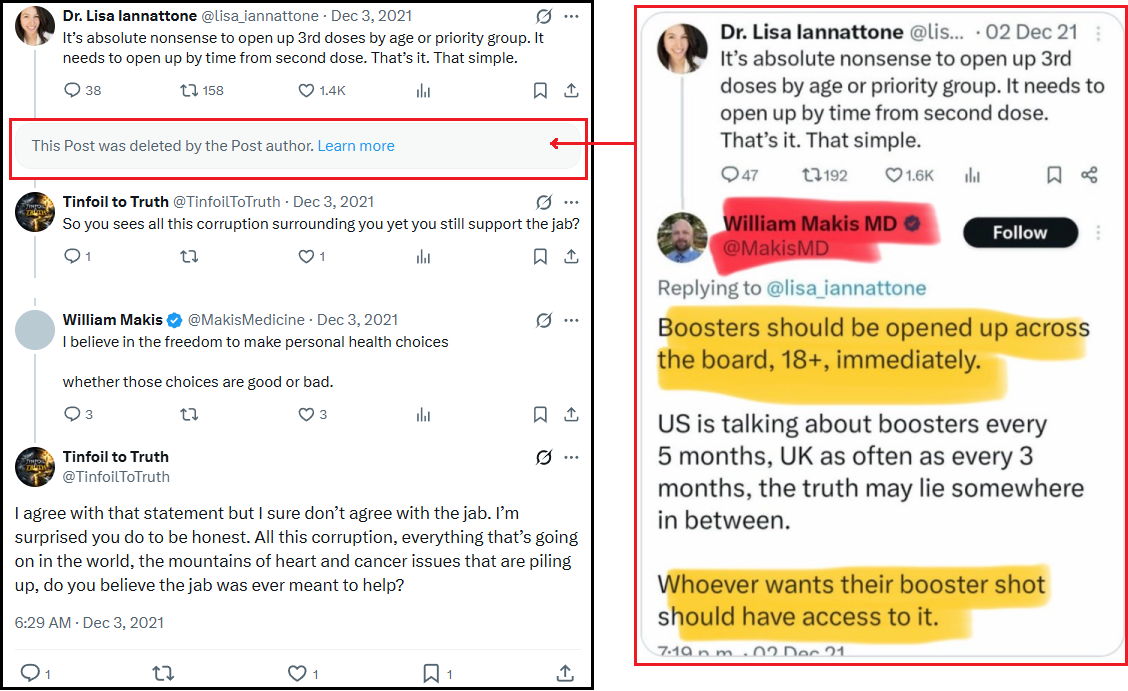
One good thing about Viliam is that he is sloppy. Although he deleted the most incriminating post, he left his replies in the now-archived thread, and LA was able to obtain a screenshot of the post he wanted to make disappear.118
2022: Fruitless Proceedings and a Growing Audience in the “Antivaccine Movement”
In July 2022, Makis filed his initial affidavits in support of his applications to have the respondents declared vexatious litigants.
On July 26, Justice Inglis issued a case-management order setting filing deadlines. She directed that Makis’s applications would be heard on January 18, 2023, and scheduled the respondents’ cross-applications to strike or summarily dismiss Makis’s lawsuits for March and April 2023. Makis would later claim that Justice Inglis's refusal to adjourn the respondents' summary judgment applications during this July 26 conference was evidence that she was part of an “extortion conspiracy” against him - a claim the Court of Appeal later dismissed as being entirely devoid of evidence.119
On November 30, Makis filed a second, massive set of affidavits totaling 521 pages, together with voluminous exhibits. The new sources confirm that these affidavits contained few relevant facts and were instead filled with his personal opinions, beliefs, and arguments. Furthermore, he used them to improperly disclose third-party medical information and to make irrelevant allegations of criminal and legal wrongdoing against an AHS executive.120
2023: Collapse of the Lawsuits and Conditional Appeals
The only “positive” aspect of the year 2023 for Viliam Makis is that he started a Substack, “Makismd.substack.com”, on which, starting early February, he started to post paywalled “miracle Cancer cures” - which he accompanied by vibrant success stories (always posted by himself & always without direct patient testimony).121
In 2023 however, the procedural maneuvering of the previous year culminated in a series of devastating judicial defeats for Makis, effectively wiping out his major civil lawsuits. Conform to his established pattern, when faced with these summary dismissal hearings, Makis chose to boycott them entirely, emailing the court to declare that they were “fraudulent and vexatious” proceedings.122
On March 28, Justice Inglis issued her decision regarding the case management hearings held in January. She completely dismissed Makis's application to have the defendants declared vexatious litigants. Furthermore, she granted the respondents' cross-applications to strike Makis's 521-page November 2022 affidavits from the court record. The court found these affidavits improperly identified patients medical information, and were filled with irrelevant arguments, opinions, and uncorroborated allegations of criminal wrongdoing rather than with any actual factual evidence.123
On April 3, Justice Gill summarily dismissed Makis's massive lawsuit against the University of Alberta and several physicians in its entirety. Makis refused to attend the hearing. Justice Gill ruled that Makis's claims were bound to fail, noting that his academic appointments were clearly conditional upon him providing clinical services at the hospital - which he no longer did. The judge also found the lawsuit was an abuse of process, statute-barred, and essentially an improper collateral attack on UA administrative decisions.124
On April 21, Justice Lee summarily dismissed Makis's claims against the CPSA in his original Action 1603-18935 met the same fate. Makis again boycotted the hearing. Justice Lee summarily dismissed the claims from the bench, ruling that they were “without any merit and an abuse of process,” lacked any supporting evidentiary record, and constituted an improper collateral attack on the CPSA's administrative proceedings.
On July 7, the Court of Appeal made clear that Makis’s vexatious-litigant status now had real bite: before he could challenge these latest defeats, he first had to obtain the court’s permission to appeal. Justice Dawn Pentelechuk was unimpressed by his usual theatrics. She refused him leave to appeal the Justice Inglis orders, rejecting his claims of bias and “extortion conspiracy” as, once again, entirely unsupported by evidence. She did, however, allow him to appeal the summary dismissals ordered by Justices Gill and Lee, largely because those rulings had finally extinguished his lawsuits altogether, and because Makis had boycotted the hearings that produced them. Even that narrow procedural opening came with a price. Conscious of the costs already imposed by his baseless litigation, Justice Pentelechuk ordered Makis to post $20,000 in security for costs for each appeal by September 30, 2023, and made clear that if he failed to pay, the appeals would be dismissed automatically and without further order.125
2024: The Launch of the “Health Coaching” Business
During later questioning under oath, Makis admitted that in July 2024 he began operating a “health coaching” business from his home, offering online consultations by email and Zoom to thousands of clients, many of them cancer patients. As part of this business, he reviewed test results and medical records and proposed individualized protocols involving repurposed drugs such as ivermectin and fenbendazole.126 The contract he sent to these “clients,” obtained and corroborated through two separate sources, is reproduced below.
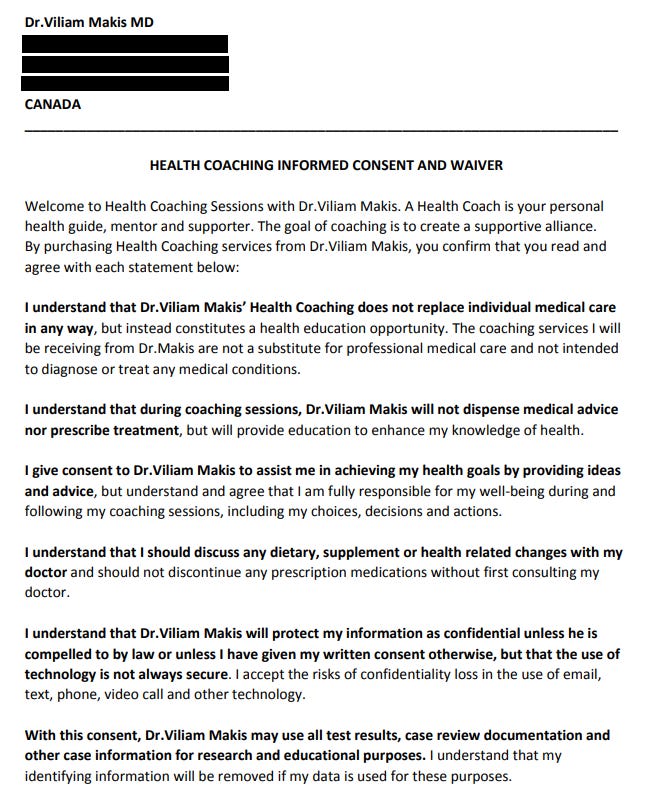
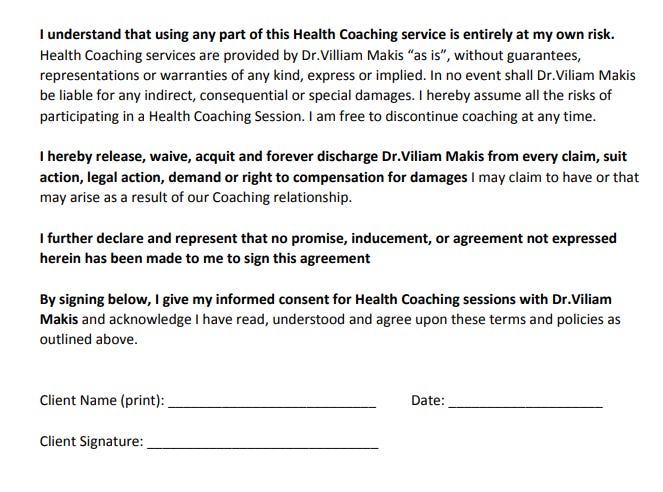
It is a remarkable document. While prominently displaying the titles “Dr.” and “MD,” it insists that Makis is providing neither medical care, nor diagnosis, nor treatment, but merely educational “health coaching.” It requires clients to assume full responsibility for their health decisions, to consult their actual primary physicians before changing medications or diet, and to accept the services strictly “as is.” At the same time, it grants Makis permission to use their anonymized records and test results for his own research, while requiring them to waive and release him from any liability, claims, lawsuits, or damages. In other words, cancer patients were invited to seek guidance from a “physician” using his medical title, receive personalized cancer-related protocols from him, and yet formally acknowledge that he bore no clinical responsibility for any of it. By recasting the relationship as a “coaching alliance” with a “client” rather than treatment of a patient, the document appears carefully designed to strip away the fiduciary duties, regulatory standards, and professional accountability that would normally attach to a doctor advising a person with cancer.
By 2024, Makis had developed another rhetorical reflex: when ordinary accusations of corruption or conspiracy no longer seemed sufficient, his opponents became pedophiles. At a June 2024 UCP fundraiser in Calgary, he attacked the CPSA by suggesting that it should be renamed “The College of Pedophiles and Child Sex Abusers of Alberta.”
True, when someone has admitted on the record to masturbating his cat and to flooding his nurses with images of obese women sitting on people’s faces, the bar for imputing sexual perversion to an opponent is already quite high.
The sordid facts behind this latest attempt to cast himself, yet again, as a victim were these: two physicians had indeed been charged in connection with child-sex offences. Both were suspended during the criminal investigations. One escaped sentencing on procedural grounds, but still saw his licence to practise medicine cancelled;127 the other, after serving time in jail, also saw his licence permanently cancelled.128 Of course, that is not how Makis framed the matter, and low-grade outlets like CairnNews helped him generate further outrage.129
The CPSA registrar publicly described the remarks as defamatory, disturbing, unfounded, and inflammatory, while noting the obvious fact that Makis did not hold a licence to practise medicine. The episode was not so much an aberration as a progression: having spent years recasting professional discipline as persecution, Makis had now taken to smearing his adversaries with one of the few labels still lurid enough to satisfy the scale of his fantasies.130
December 2024 also marked the creation by Makis by creating a Givesendgo to “fight the Trudeau-tyranny” - on which he managed to raise - by lying to his public on the root cause of the procedures against him - over USD $200,000.131
2025: CPSA Injunction and Unauthorized Practice of Medicine
In 2025, the College of Physicians and Surgeons of Alberta (CPSA) launched direct legal action against Dr. Makis to shut down the “health coaching” business he had started in 2024. Because Makis’s medical licence had been cancelled in 2019, the CPSA argued that he was actively practising medicine without a licence and endangering the public.
On February 10, following inquiries from members of the public about Makis’s online cancer-treatment consultations, CPSA Registrar Dr. Scott McLeod sent him a formal cease-and-desist letter. The CPSA demanded that he stop holding himself out as a physician, radiologist, and oncologist, and cease providing medical services directly to the public. True to form, Makis responded with ad hominem attacks against Dr. McLeod and the CPSA’s legal counsel.132
On June 24, the CPSA issued a public statement warning Albertans that Makis was not a licensed physician. It explicitly cautioned that his use of the title “doctor” while providing medical opinions and advice about cancer treatments lacked regulatory safeguards and could lead to misdiagnosis or inappropriate treatment.133
On August 15, the CPSA finally asked the Court of King’s Bench to shut the operation down. Makis responded with a now familiar fiction: he claimed that he was not practising medicine at all, but merely acting as an independent researcher and “health coach” who provided information rather than medical advice, and therefore fell outside the College’s jurisdiction. Justice Yamauchi rejected the argument and granted an interim interlocutory injunction. Makis was barred from representing himself as a licensed physician in Alberta, from offering health services to the public - including advice or consultations about cancer treatment - and from using protected titles such as “doctor,” “oncologist,” “MD,” or “Dr.” in connection with those services. He was also ordered to remove the offending titles and abbreviations from his social-media profiles by September 22, 2025.134
Instead of complying with the injunction, Makis doubled down. During questioning under oath on November 3, 2025, he admitted that his health-coaching business had grown to 7,000 clients, many of them cancer patients. He conceded that he charged clients money, reviewed their test results and medical records, and provided them with customized protocols involving repurposed drugs such as ivermectin.
Makis attempted to skirt the injunction by using what the courts later called “weasel words,” referring to his patients as “clients” and his medical advice as “information” and “research.” Meanwhile, the CPSA continued gathering extensive evidence throughout late 2025 showing Makis launching a YouTube channel, posting on Substack, and boasting online about running “the largest Ivermectin cancer clinic in the world,” in blatant defiance of the August injunction.
That continued defiance set the stage for early 2026, when the CPSA dragged Makis back into court to have him held in civil contempt and exposed to the possibility of imprisonment.
2026: Contempt of Court, Permanent Injunction and Attempting to escape to Florida
2026 brought the result that years of grievance, evasion, and semantic trickery had long been inviting: contempt of court and a permanent injunction. After openly defying the August 2025 interim order, Makis was hauled back before the Alberta courts. In January, the Court of Appeal refused to stay the injunction and sent the matter forward for a hearing on both contempt and the CPSA’s request for a permanent order.135 At the February hearing, the CPSA produced extensive evidence that Makis had continued advertising himself online as an “MD” and “oncologist,” boasting of running “the largest Ivermectin cancer clinic in the world” with roughly 7,500 patients, and promoting drugs such as fenbendazole and mebendazole. Makis responded with the usual mixture of denial and word games, claiming that some posts came from impersonators, insisting that he merely gave “information” and “research” to “clients,” and suggesting that he was relocating to Florida, where he said he was licensed to practice.
On March 4, Justice Mah rejected all of it. In a ruling that was as unsurprised as it was unfavorable to Makis, the court found him in civil contempt, rejected his attempts to evade the injunction through what it called “weasel words,” and noted his characteristic looseness with the facts, including his misleading claims about being licensed in Florida. The interim order was converted into a permanent injunction: Makis was barred from using titles such as “Dr.,” “MD,” and “oncologist,” and prohibited from offering health services or cancer-treatment advice in Alberta.136
Concluding that an ordinary fine would not deter him, the court gave him a choice: comply immediately or risk jail. He was ordered to scrub the offending titles from his social media within 72 hours and to pay the CPSA’s legal costs at a heightened rate. Faced at last with a sanction he could not easily talk his way around, Makis retreated - while, naturally, recasting the outcome as persecution and assuring his followers, falsely, that his Florida licence was secure.
Conclusion
We could go on for quite some time about the countless lies of Viliam Makis.
At this point, the reader may well wonder why Makis claims that Trudeau - as antipathetic as he may be - was directly involved in his downfall. Having untangled Makis’s endless web of lies and grievances, we are in a good position to appreciate how difficult it can be to discern the truth amid the noise. In the end, however, the matter comes down to a very simple question.
In letters to public officials, Makis claimed that “Sarah Rayner had retracted her testimony.”137
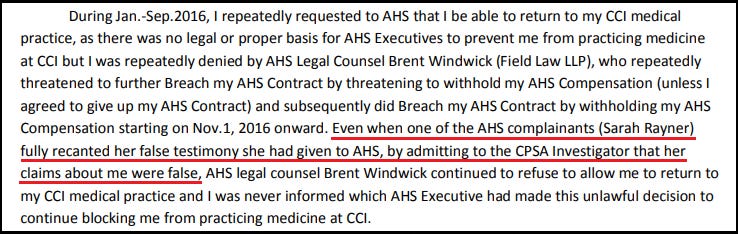
That is the testimony accusing him of zoophilia and of bombarding his nurses with pornography featuring obese women - for which she provided 5 pages of evidence. We find that claim extremely difficult to believe. Assisted by an excellent lawyer, Makis was confronted with these accusations and made considerable efforts to minimize them - to say that he had merely “felt comfortable enough to talk about it” - but he did not deny the facts themselves. If these accusations are true, then much of the rest becomes secondary - and one can only observe that Canada is an extraordinarily tolerant country: in many others, he would likely have been dismissed the day such conduct was established.
On X, Makis went further still, effectively blaming Rayner herself and claiming that she had been bribed to testify.138
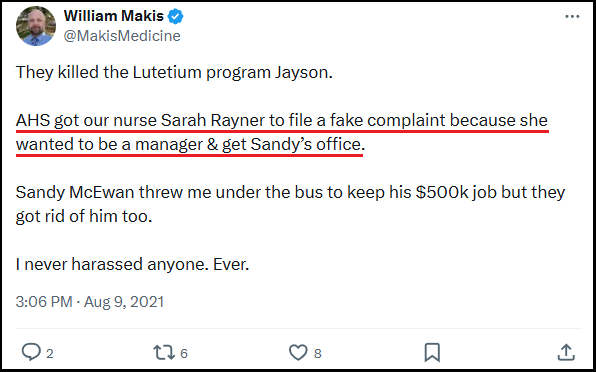
If, on the other hand, she truly retracted her accusations, then much of the rest is noise. It is the rewriting of that original story that sent him down his endless trail of lawsuits.
I therefore asked Viliam Makis, twenty-four hours before the publication of this article, whether he had any proof that Sarah Rayner had in fact retracted her statements. Had he produced such proof, this article would, of course, never have been published.
I had to use an alternate account, as he had blocked my main X account in December 2024, after I had uncovered that he was already earning $45,000 a month from Substack while claiming to be destitute.139
Makis first ignored my question. Then, when Lyndsey House took notice of my post and challenged him further, Makis went full DARVO on her and immediately deleted his original post about Sarah Rayner.
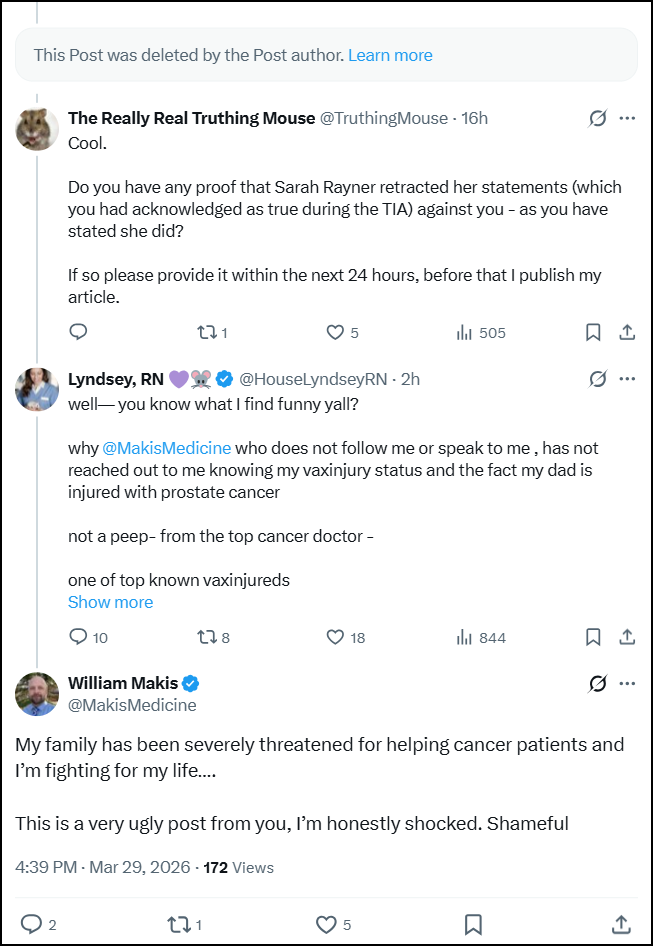
The post, of course, had already been archived, which means that anyone who pastes the original post URL into a browser can judge for himself how peaceful Viliam’s conscience really is…
I therefore take it that Makis will not be producing this crucial evidence that Sarah Rayner “lied and retracted her statement,” but rather that he was, once again, lying, blame-shifting, and casting himself as the victim.
💬 Join the conversation
Want to like, comment, or share this article?
Head over to our Substack page to engage with the community.
Likes, comments, and shares are synchronized here every 5 minutes.
💬 Join the conversation
Want to like, comment, or share this article?
Head over to our Substack page to engage with the community.
Likes, comments, and shares are synchronized here every 5 minutes.